Fuel Injection & Engine Management
L-Jetronic wiring, fuel pressure targets, sensor checks, idle trim, roller lifters, and CIH turbo notes, documented for Ascona, Manta, Monza, and GT.
Browse reference areas
Browse reference areas


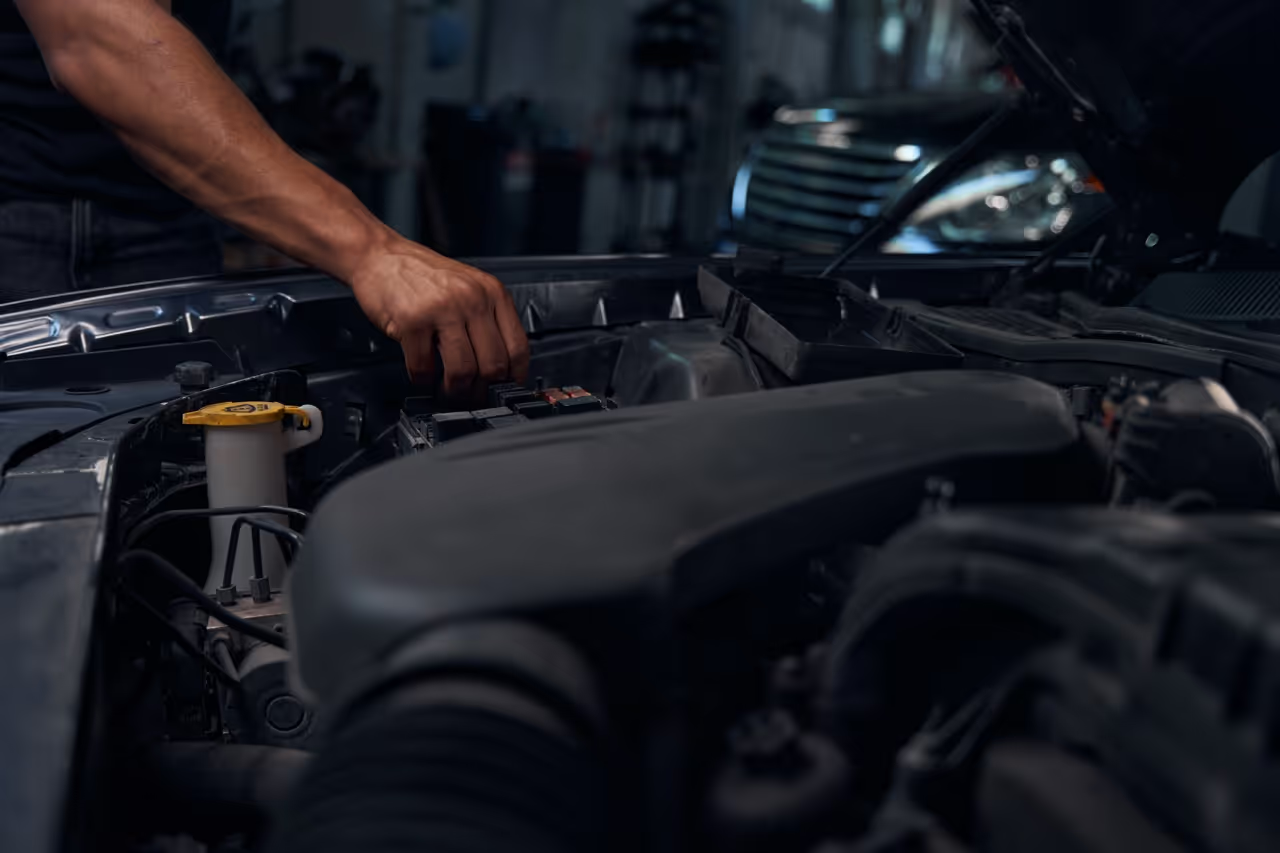
Opel Tuners documents Bosch L-Jetronic and LE-Jetronic on the CIH four-cylinder family, the injection systems Ascona B, Manta B, Kadett C, Monza, and Opel GT builders actually run in the field. This reference is written for people who already have the car apart: you need pinouts, pressure targets, sensor behaviour, relay layouts, and the order of work so the first drive is not a debugging session on the shoulder of the motorway.
Unlike generic EFI marketing, these notes assume European-market hardware, ageing harnesses, and the mixture of donor parts from scrap cars. The archive cross-links chassis and drivetrain articles because injection projects rarely end at the engine bay, brake capacity, ride height, and gearbox ratios change once power and weight distribution move. When you are planning a swap, read the Carb-to-Injection hub for sequencing, then return here for system theory and tuning discipline.
Bosch L-Jetronic was the dominant path from carburettors to reliable street fueling on European four-cylinders through the late 1970s and 1980s. On Opel CIH engines it is not a retrofit curiosity, it is the factory architecture on many injected cars, and the donor pool for conversions is enormous. Understanding airflow measurement, batch injection timing, and analogue trim is still the fastest way to get a Manta or Ascona driving cleanly without importing a standalone ECU that fights the original harness philosophy.
LE-Jetronic refined idle control, wiring, and some plumbing details while keeping the same mental model: measure air, correct for temperature and throttle state, deliver fuel in open-loop or closed-loop patterns depending on market and year. Treat LE as an evolution, not a different religion. compare your AFM, ECU part number, and injector connector before you buy a “complete kit” from a car that does not match your engine code.
L-Jetronic is airflow-metered, batch-fire injection. The control unit receives engine speed, coolant temperature, throttle position, and airflow via the AFM flap/potentiometer stack. Fuel delivery is not “mapped” in the modern sense; the ECU calculates pulse width from lookup tables and correction factors. That makes sensor integrity and fuel pressure stability more important than chasing a mythical “base map” on a laptop.
The air-flow meter is both sensor and restrictor. A sticky flap or worn track shows up as hesitation, rich spikes, or lean stumble that moves with throttle rate, not steady-state rpm. Always verify mechanical free play and potentiometer continuity before you replace injectors. On many field cars the AFM is the root cause of “new injectors did nothing.”
Typical field targets on many Opel L-Jetronic installs run roughly 2.5–3.0 bar at the rail, always verify with a gauge on a known-good regulator and return line. Weak return flow shows up as rising rail pressure at idle and rich running that no trim fixes. Oversized injectors shorten pulse width and make idle coarse; match injector flow to measured airflow, especially when you add camshaft or head work later. Document your static fuel pressure at idle, 2500 rpm, and 4000 rpm before you touch trim screws.
Common failure modes we document: tired AFM potentiometers and sticky flaps; coolant temp sensors reading low because of air pockets at the thermostat housing; throttle switches with blurred idle/WOT contacts; corroded relay sockets under the battery tray; merged donor harnesses where a six-cylinder ECU pinout was assumed to match a four-cylinder label; and earth points that look fine but measure several ohms to the battery negative.
LE-Jetronic appears frequently on Manta-era installs and donor cars. Plumbing, idle-air paths, and trim habits differ from early L-Jetronic. Before you copy a harness from a forum photo, compare your ECU label, AFM housing, and injector harness length against a documented build. The MantaBlog LE-Jetronic walkthrough remains one of the clearest community references for trim procedure and practical plumbing, use it alongside our archive notes, not instead of them.
Idle stability on LE often involves both the throttle switch and the idle-air bypass circuit. If you chase mixture with the CO screw while air bypass is wrong, you will get a drivable idle and miserable transition off idle. Verify vacuum integrity at the intake manifold and charcoal canister plumbing — European cars with age often have cracked small-bore hoses that do not show up in a smoke test at the brake booster.
Most Opel CIH projects still start on carburettors. The Cicco's Injection Conversion article is the anchor sequence: intake selection, fuel system first, harness routing, sensor placement, first fire, idle trim, then part-throttle drivability. Read the dedicated Carb-to-Injection hub if you are mid-swap and need the work order spelled out step by step.
Plan a return-style fuel system before you touch the loom: tank pick-up or surge pot, pre-filter, pump (Bosch 058 and period Opel lift pumps appear often in field notes), post-filter, regulator with return to tank. Prime and leak-check before cranking. Document static timing and only chase WOT after idle and cruise are stable, most abandoned conversions failed at idle, not at peak boost.
Intake manifold choice affects injector spray targeting and idle quality. A manifold that was excellent for a 32/36 carb may place injectors in a poor stream for part-throttle cruise. If you must use an adapter plate, photograph spray pattern during cranking with fuel return disabled for safety, know what you are feeding the valves before you road test.
Roller Lifters documents CIH valvetrain conversion: parts selection, clearances, oiling, and the reliability issues that appear when lift increases without revisiting valve spring pressure and cam profile. Injection and valvetrain projects often overlap on the same engine — do not assume a fresh AFM tune covers mechanical noise or upper-end flutter.
Increased overlap and lift change the effective idle vacuum signal the AFM sees at a given throttle opening. Re-trim after cam changes, and expect to revisit ignition timing if you moved compression or chamber efficiency at the same time.
Turbo Efficiency covers compressor matching on CIH engines, boost control that does not destroy L-Jetronic metering, intercooling choices, and keeping the combination durable on street octane. Forced induction changes injector duty, ignition margin, and often exhaust manifold mass, revisit brake upgrades and driveline angles when power and ride height move together.
On L-Jetronic turbo builds, airflow meter location and plumbing diameter matter enormously. Undersized charge pipes before the AFM can make the ECU believe the engine is starved while boost is actually excessive downstream. Many durable street setups prioritize predictable low-boost response and charge cooling over peak dyno numbers, CIH headroom and rod safety margins are finite.
Injection ECUs expect a clean rpm signal, usually from the distributor or a dedicated trigger wheel on later adaptations. Misfires from weak coil, incorrect dwell, or cracked trigger wires show up as rich running and sooty plugs because unburned fuel keeps arriving. Fix ignition before you richen mixture to mask stumble.
Verify advance curve against load. Street Opels spend minutes at partial throttle; too much advance at cruise raises combustion temperature and makes lean-trim corrections fight knock-like symptoms. Document total advance at 2000 and 3500 rpm once fueling is stable.
Independent technicians and clubs have linked to this archive from long-standing web resources. Compare your hardware against John Powlton's EFI notes for system layout fundamentals, 205 GTi Drivers' injection comparison when evaluating management families, the Manta B link directory for regional part-number habits, and the international Opel link roundup when a connector or sensor does not match your market.
Platform context for Ascona-family builds also appears in broader Opel history write-ups such as Ascona background summaries,useful when you are explaining to a non-Opel machinist why your donor harness came from a different market car.
1 — Fuel system integrity. Mount pump and filters, plumb return, set regulator, verify stable pressure at idle and 3000 rpm. Fix plumbing before ECU diagnosis.
2 — Harness and power distribution. Route away from exhaust heat; label relays; fuse each load sensibly. Verify AFM, CTS, TPS/throttle switch, and trigger inputs against your ECU documentation.
3 — First fire and idle trim. Confirm pump prime, set safe timing, trim idle to a known CO/lambda target for your market. Log any hunt, usually TPS, vacuum leaks, or pressure drift.
4 — Part-throttle and cruise. Fix flat spots before advancing timing for power. Street Opels live at partial throttle; WOT is a small fraction of miles.
5 — Forced induction (if applicable). Revisit duty cycle, fuel headroom, charge temperature, and knock margin. Confirm brakes and driveline match new output.
6 — Cross-pillar checks. Ride height and rear link angles affect traction which feels like “tuning problems” on boost. Gearbox choice affects load at a given road speed — see Drivetrain & Gearing and Torque-Tube & Gearbox Reference before you declare the tune finished.
Return to all reference areas when you need the other editorial pillars — chassis geometry and drivetrain references are written to be used together with this fuel-injection material, not as optional extras.
When mixture problems follow throttle rate but not rpm, suspect the AFM first. Check flap return spring, potentiometer sweep with an ohmmeter at the connector (key off, harness disconnected per your procedure), and vacuum leaks downstream of the meter that fool idle trim. A smoke test at the manifold is still worthwhile even when the AFM looks fine, split rubber elbows under the intake are common on cars that sat.
Do not adjust the AFM spring or bypass screw until fuel pressure and ignition are verified. Many “rich idle” complaints are 0.3 bar high rail pressure and a compensating CO trim that makes cruise lean and snappy off-idle.
Calculate required flow from target horsepower, brake specific fuel consumption, and duty cycle headroom at your peak rpm. Street CIH builds rarely need the largest injectors in the catalogue; they need injectors that idle cleanly and still reach adequate duty at WOT. Log duty indirectly by watching pulse width stability at fixed rpm points after trim is correct.
Route injector and sensor harness away from exhaust manifolds and tight to the tunnel where factory cars did. Replace heat-cooked sections rather than tape-over. Star grounds at the battery negative with short straps to body and engine, measure resistance, do not assume bright metal means good ground.

Reference for the Opel building community.

